Caspar Henne(n)berg(er) (sometimes also 'Kaspar'.
1529 – 29 February 1600.
Was a German Lutheran pastor, historian and cartographer.
Hennenberger was born in a Franconian place given as Erlich (Erlichhausen?) and started to study Lutheran divinity at the University of Königsberg in 1550. In 1554 he began to work at the congregation of Georgenau and in Domnau. Probably in 1561 he moved to Mühlhausen, where he worked as a Lutheran Pastor for the next 29 years.
With the patronage of Duke Albert of Prussia Hennenberger published the first detailed map of Prussia in 1576, the book 'Kurze und wahrhaftige Beschreibung des Landes zu Preussen' (short and truthful description of the land Prussia) in 1584 and 'Erklärung der preußischen größeren Landtafeln oder Mappen' (explanation of the larger Prussian maps) in 1594.
In 1590 Hennenberger became the Pastor of the Large Hospital at Königsberg-Löbenicht, where he died in 1600. He was buried in the Hospital's Church.
Bland arbeten.
Kurze und wahrhaftige Beschreibung des Landes zu Preussen.
Erklärung der preußischen größeren Landtafeln oder Mappen.
c. 1703-66
HENDRIK DE LETH (THE YOUNGER) ft. 1788
Engraver, publisher and painter, active in Amsterdam, worked for the Visscher family and eventually took over the business. De Leth is better known as an artist and engraver than as a cartographer although his historical atlas of the Netherlands was a very popular work. His son, Hendrik de Leth (the Younger), published a World Atlas in 1788.
The first Buddhist world map printed in Japan and the prototype for all subsequent Buddhist world maps printed in Japan until the late nineteenth century. The author, Hotan (1654-1728) was a scholar-priest and founder of the Kegonji Temple in Kyoto. The earliest known example in Japan is the Gotenjiku Zu (Map of the Five Indies) by the priest Jukai dating from 1364 and now preserved in Horyuji Temple in Nara. However Hotan’s map was revolutionary in being the first printed Oriental map to introduce detailed Western cartographic information into this traditional Buddhist cosmological view and attempt to merge the two together into a comprehensible form. Europe is depicted as a series of islands in the upper left of the image whilst South America is likewise another island in the lower right of the image. Africa is omitted completely. China and Japan are clearly defined in the upper right of the map. The popularity of the map is evidenced by the fact that although the map is dated 1710, it was reissued unchange...
Bland arbeten.
Nantanbushu Bankoku Shoka No Zu [Map of the Universe as a result] [Kyoto: Uhei Bundaiken, Hoei 7 (1710)]
Sotheby's. Murogo & Unno, “The Buddhist World Map in Japan” in /M Xvi (1962); H. Cortazzi, “Island of gold, p.38 pl.48; Harley & Woodward, “The History of Cartography, 2.2, pp. 428ff and Fig. 11.59; Nanba, “Old Maps of Japan, p. 179 pl.8; K. Yamashita, “Japanese Maps of the Edo Period, pp. 32-33 ill.1.
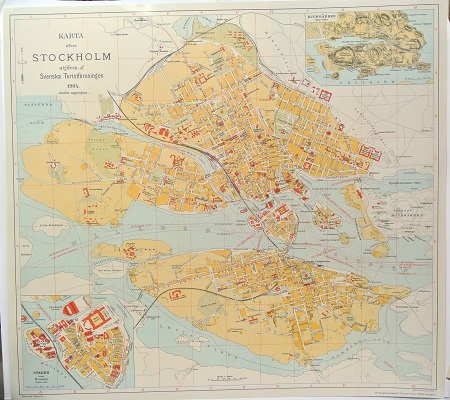
Karta öfver Stockholm. - 1904.