Född o. 1615, trol. i Dresden, där V:s namn dock icke anträffats 1610-20 i de tre förs., som ha sina dopböcker bevarade, död efter 1654.
Kopparstickare. Sannolikt son av målaren och kopparstickaren Christopher V., som 1615-50 var bosatt i Dresden. Vistades 1636-54 i Sverige och var här verksam för svenska hovet. Graverade 1639, 25 kopparmått »därefter målen i riket justeras skola». Fick 1642 23/7 i uppdrag att utföra fyra kopparstick till Finska bibeln för 339 dlr smt (Kammarkoll. prot.). Hade 1644 åt hovet »uthstucket een crona och 300 exemplar af stycket till waar tecken åt dem som skola gå och see balletten» för 15 dlr kmt (Hovstatsräk.). »Kopparstickaren Sigismundus Vogel blef kalladt och medh honom handlat at uthsticka uthi koppar 200 st. runiske saker» (Kammarkoll. prot. 1647 10/4). 1647 medföljde V. svenska beskickningen till Moskva och träffade där konterfejaren Johan Detters. Denne överlämnade till V. 15 »schillerier» till försäljning enligt Sigismunds utsago. Detters påstod sig emellertid ha sålt tavlorna till kopparstickaren. Kontroversen ledde till en långvarig process i Stockholm, som V. 1649 förlorade. — Uppbar 1650 31/10 67:16 d...
Bland arbeten.
J. MÅNSSON, Een siö-book … om siö-farten i öster-siön, Sthlm 1644: Johan Månsson, 1644, kpst. (Plåten förvaras i Statens hist. mus.).
Petrus Brahe, kpst. (2 varianter), jämte ätten Brahes stamträd och karta över grevskapet Visingsborg, å samma blad, kpst. (plåten förvaras å Skokloster), gravmonument över Birger Pedersson och hans hustru Ingeborg i Uppsala domkyrka, kpst., samt 5 vignetter med vapen och sigill, kpst.
O. LAURELIUS, Spiritualis forma regiminis, Västerås 1654: försättsblad, länstol med brinnande ljus på karmarna, etsn.
Descriptio pompae restitutionis ornamentorum equestris ordinis a periscelide Gustavi Magni, Gustav II Adolfs insignier till Strumpebandsorden återlämnas i London 1635, 1639, 2 sammanfogade blad, kpst.
De la Gardieska palatset Makalös i Stockholm, efter H. J. Kristler, 1647, kpst.
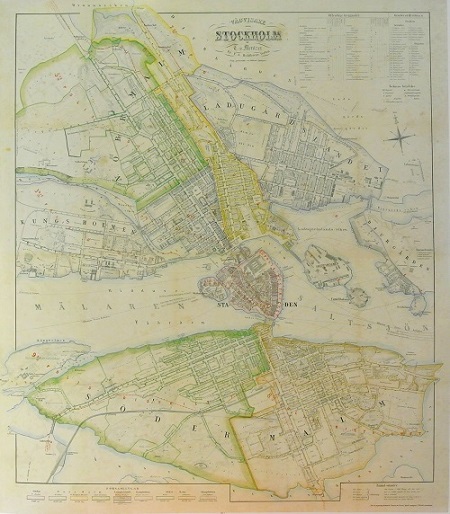
Totius orbis arctoi metropolis celeberrima Stockholmia, o. 1650, 6 sammansatta blad, kpst. (Plåtarna förvaras i NM.)
J. MÅNSSON, Pass cort öfver Öster siöön.
Hultmark, 1944.
GERRITSZ [GERARD, GERARDUS, GHERRITSZOON van ASSUM].
Hessel 1581-1632.
Gerritsz was apprenticed to W. J. Blaeu as an engraver before starting in business on his own account. He worked closely with Petrus Plancius and his merit may be judged by the fact that he was appointed Cartographer to the Dutch East India Company in preference to Blaeu and subsequently held the same position in a newly formed West India Company. With the new company he came into touch with Johannes de
Laet for whom he prepared a number of new maps of America in the latter's Nieuwe Wereldt published in 1625. His most important early work was a chart showing Henry Hudson's discoveries in his voyage of 1610-11: it is the first to give an outline of Hudson's Bay and indicates Hudson's belief that he had found a way to the North West Passage.
Engraver, cartographer, publisher and bookseller, b. Assum, apprenticed as engraver to Blaeu, Cartographer to Dutch E. India Co. 1617, fl. 1607; from 1612 using sign 'in de Paskaert' or 'sub signo Tabulae Nauticae'. Addresses: (1) opt Water bij die oude Brug [1609...
Tooley.
Kâtip Çelebi, Mustafa bin Abdullah, Haji Khalifa or Kalfa, (1609, Istanbul – 1657 Istanbul)
Kâtip Celebi was an Ottoman scholar. A historian and geographer, he is regarded as one of the most productive authors of non-religious scientific literature in the 17th century Ottoman Empire. Among his best-known works is the Kashf al-?un?n ‘an as?m? al-kutub wa-al-fun?n, ('The Removal of Doubt from the Names of Books and the Arts'), a bibliographic encyclopaedia, written in Arabic, which lists more than 14,500 books in alphabetic order.
Life and works
The son of a soldier, he himself was a soldier for ten years until a heritage made him turn to a more contemplative life. As the accountant of the commissariat department of the Ottoman Army in Anatolia, he accompanied the Ottoman army in the campaign against Baghdad in 1625, was present at the siege of Erzurum, and returned to Istanbul in 1628. In the following year he was again in Baghdad and Hamadan, and in 1633-34 at Aleppo, whence he made the pilgrimage to Mecca (hence his title Hajji). The following year he was in Erivan and then returned to Consta...
Bland arbeten.
Cihannüma (The mirror of the world) Constantinople, Ibrahim Müteferrika, 1732. First edition.
This is the second work by Kâtip Celebi published in 1729. The author was a well known writer on history and geography and a bibliophile and in this work intended to publish a universal system of geography. In fact only part of the work (including the description of Asia Minor) was completed by Kâtip who used European and Arabic and Persian sources, and the whole was supplemented and edited by Ibrahim, who dedicated it to the grand vizir of Sultan Mahmud II, Ali Pasha.
The picture is showing the map of the Indian Ocean and the China Sea that was engraved in 1728 by the Hungarian-born Ottoman cartographer and publisher Ibrahim Müteferrika; it is one of a series that illustrated Katip Çelebi’s Cihannuma (Universal Geography), the first printed book of maps and drawings to appear in the Islamic world.
Amiral Häggs flaggkarta. - Stockholm 1888.
Nils Simonssons adliga ätt - C. H. Tersmeden ca 1900.