Kâtip Įelebi, Mustafa bin Abdullah, Haji Khalifa or Kalfa, (1609, Istanbul 1657 Istanbul)
Kâtip Celebi was an Ottoman scholar. A historian and geographer, he is regarded as one of the most productive authors of non-religious scientific literature in the 17th century Ottoman Empire. Among his best-known works is the Kashf al-?un?n an as?m? al-kutub wa-al-fun?n, ('The Removal of Doubt from the Names of Books and the Arts'), a bibliographic encyclopaedia, written in Arabic, which lists more than 14,500 books in alphabetic order.
Life and works
The son of a soldier, he himself was a soldier for ten years until a heritage made him turn to a more contemplative life. As the accountant of the commissariat department of the Ottoman Army in Anatolia, he accompanied the Ottoman army in the campaign against Baghdad in 1625, was present at the siege of Erzurum, and returned to Istanbul in 1628. In the following year he was again in Baghdad and Hamadan, and in 1633-34 at Aleppo, whence he made the pilgrimage to Mecca (hence his title Hajji). The following year he was in Erivan and then returned to Consta...
Bland arbeten.
Cihannüma (The mirror of the world) Constantinople, Ibrahim Müteferrika, 1732. First edition.
This is the second work by Kâtip Celebi published in 1729. The author was a well known writer on history and geography and a bibliophile and in this work intended to publish a universal system of geography. In fact only part of the work (including the description of Asia Minor) was completed by Kâtip who used European and Arabic and Persian sources, and the whole was supplemented and edited by Ibrahim, who dedicated it to the grand vizir of Sultan Mahmud II, Ali Pasha.
The picture is showing the map of the Indian Ocean and the China Sea that was engraved in 1728 by the Hungarian-born Ottoman cartographer and publisher Ibrahim Müteferrika; it is one of a series that illustrated Katip Įelebis Cihannuma (Universal Geography), the first printed book of maps and drawings to appear in the Islamic world.
Né ā Paris en 1795 est un géographe franįais.
Auguste Henri Dufour étudia avec Lapie et travailla avec lui ā plusieurs cartes du Dépot de la Marine. En 1824, il publia pour la premičre fois, sous son nom seul, une Analyse géographique de la carte de Palestine, et prit part dčs ce moment ā une foule de publications historiques ou topographiques dont il dressa et dessina les plans et les cartes. Ses ouvrages principaux sont :
* l'atlas élémentaire et universel de géographie ancienne et moderne (1828)
* plusieurs Précis de systčme planétaire et de cosmographie
* l'atlas joint ā la France illustrée de Victor Adolphe Malte-Brun (1855)
* l'atlas Dufour, atlas universel, physique, historique et politique de la France, de ses départements et de ses colonies (106 cartes). (1857)
Parmi les élčves d'Auguste Henri Dufour figure Alexandre Vuillemin.
Född 1801 26/2 i Stockholm, död 1830 21/8 i samma stad (Klara).
Kopparstickare. Son av skomakaren Johan Gustaf F. Och Brita Ulrika Sundberg. Elev av kopparstickaren och kartgravören Carl Gustaf Lundgren.
Bland arbeten.
A. J. DE ROSNY, Geografisk karta öfver Europa, u. o. o. å.: 7 blad.
Jordglobskarta.
Hultmark, 1944.
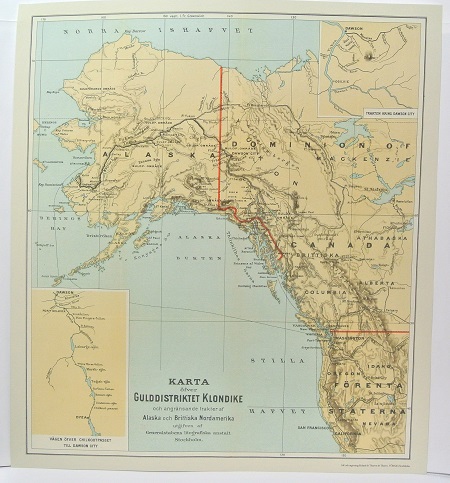
Gulddistriktet Klondike - ca 1897.
von Platen - Tyskland ca 1800.