VÖBAM - Din källa till den äldre bild- och kartvärlden. - Tel: 08-102121 - Epost: info@vobam.se

Biografier.

Keere, Pieter van den [Kaerius, Petrus]

1571-c. 1646.
Pieter van den Keere was one of a number of refugees who fled from religious persecution in the Low Countries between the years 1570 and 1 590. He moved to London in 1584 with his sister who married Jodocus Hondius, also a refugee there, and through Hondius he undoubtedly learned his skills as an engraver and cartographer. In the course of a long working life he engraved a large number of individual maps for prominent cartographers of the day but he also produced an Atlas of the Netherlands (1617-22) and county maps of the British Isles which have become known as Miniature Speeds, a misnomer which calls for some explanation.
In about 1599 he engraved plates for 44 maps of the English and Welsh counties, the regions of Scotland and the Irish provinces. The English maps were based on Saxton, the Scottish on Ortelius and the Irish on the famous map by Boazio. These maps were not published at once in book form but there is evidence which suggests a date of issue (in Amsterdam) between 1605 and 1610 although at
...


Formey, Jean Henri Samuel de.


Bland arbeten.
Encyclopédie ou dictionnaire universel raisonné des connaissances humaines.


ARROWSMITH, AARON.

1750-1823.
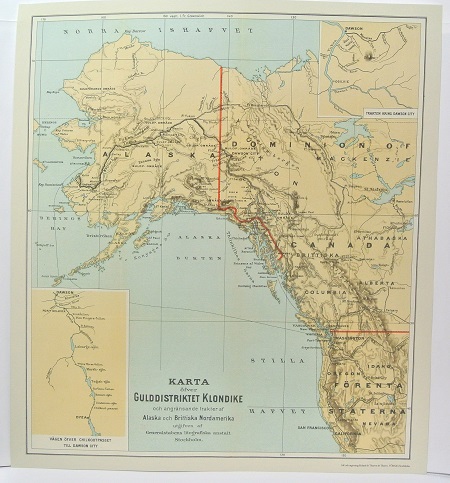
He was an English geographer (mapmaker) and member of the Arrowsmith family of geographers. He moved to Soho Square, London from Winston, County Durham when about twenty years of age, and was employed by John Gary, the engraver and led for some years the office of hydrographer to the king. In January 1790 he made himself famous by his large chart of the world on Mercator projection. Four years later he published another large map of the world on the globular projection, with a companion volume of explanation. The maps of North America (1796) and Scotland (1807) are the most celebrated of his many later productions. He left two sons, Aaron and Samuel, the elder of whom was the compiler of the Eton Comparative Atlas, of a Biblical atlas, and of various manuals of geography.
The business was thus carried on in company with John Arrowsmith (1790-1873), nephew of the elder Aaron. In 1821, they published a more complete North American map from a combination of a maps obtained from the Hudson Bay Company and Aaro
...
Bland arbeten.
First map of North America, 1790
A Map Exhibiting All the New Discoveries in the Interior Parts of North America, January 1, 1795 (Other editions 1801, 1802, 1804 and 1816 featuring roads)
Chart of the South Pacific, 1798
A New Map of Africa, 1802
Map of Countries Round the North Pole, 1818
Ogden map (North America), 1821 (2nd edition : 1834)


Stockholm - Mentzer ca 1860.


'F. R. Neumüllers Bryggeri, Stockholm.' - Gustaf Pabst 1870-1879.


Sök efter biografi:

Du sökte på: 10588

Klicka på valfri bokstav för att återgå till hela listan.  

A  B  C  D  E  F  G  H  I  J  K  L  M  N  O  P  Q  R  S  T  U  V  W  X  Y  Z  Å  Ä  Ö

Fries, Elias Magnus.

Biografiska uppgifter:Född den 15 augusti 1794 i Femsjö i Småland (Jönköpings län), död den 8 februari 1878 i Uppsala.
Elias Magnus Fries, var en svensk botaniker. Han var professor i Uppsala och ledamot av Svenska Akademien 1847–1878 (stol 14) samt rector magnificus för Uppsala universitet 1839 samt 1853–1854.
Fries är framför allt känd för sitt växtsystematiska arbete rörande svampar, Systema mycologicum (tre delar, 1821–1832), och räknas som en av den moderna mykologins grundläggare. I Statens porträttsamling på Gripsholms slott återfinns en bröstbild av Fries utförd av Johan Gustaf Sandberg 1838.
Han ligger begravd på Uppsala gamla kyrkogård.


Fries var son till kyrkoherden, prosten Thore Fries (1762–1839) från Femsjö i Småland och Sara Elisabeth (Sara-Lisa) Wernelin (1769–1837). Hans släkt, den så kallade 'Eliassläkten', härstammar från Adam Jonsson Fries (1640–1710), en sporrsmed från Norrköping. Namnet 'Frijs' kom in i släkten med Adam Jonsson, och fortsatte med hans son Thore Adamsson (1683–1732) – 'Fris', 'Friese', 'Frijs eller 'Fries'.

Fries studerade ursprungligen botanik vid Lunds universitet och var elev till Anders Jahan Retzius och Carl Adolph Agardh, han blev 1814 docent i botanik i Lund och fick 1819 en personlig tjänst som botanices adjunkt. Fries erhöll 1824 professors titel och blev 1828 botanices demonstrator.[1] År 1834 lämnade han Lund för Uppsala där han erhöll den Borgströmianska professuren i praktisk ekonomi (från 1851 botanik och praktisk ekonomi) och han blev då också prefekt för den botaniska trädgården och museet där. 1859 avgick han från professorstjänsten och blev emeritus, medan han kvarstod som direktör av botaniska trädgården till 1863. Hans stora växtsystematiska arbete rörande svampar, Systema mycologicum, utkom i tre delar 1821–1832, och kom att räknas som ett viktigt arbete för utvecklandet av den moderna mykologin. Fries' arbete över lavarna, Lichenographia europæa reformata (1831) förlänade honom den Linnéanska större guldmedaljen. Han invaldes 1821 som ledamot nummer 392 av Kungliga Vetenskapsakademien. 1847 blev han medlem av Svenska Akademien och 1868 hedersdoktor vid Lunds universitet.
Han var även riksdagsman och representerade Uppsala universitet vid riksdagarna 1844–1845 och 1847–1848, samt ledamot av konstitutionsutskottet.
Fries var också styrelseledamot för Ultuna lantbruksinstitut 1846–1859 samt ledamot i en kommitté för utarbetandet av nya universitetsstatuter.

Under sin tid i Uppsala var Fries inspektor vid Smålands nation.
Elias Fries gifte sig år 1832 med kyrkoherdedottern Christina Wieslander (1809–1862). Hans son Teodor (Thore) Magnus Fries blev professor i botanik och sönerna Elias Petrus och Oscar Robert studerade båda vidare inom mykologi. Sonen Elias Petrus liksom dottern Susanna Christina tecknade båda svampar och ett antal originalplanscher av dessa finns bevarade i Uppsala. Familjen Fries brukar omnämnas som 'The Fries Family of Botanics'.

Tillbaka till början.