
Ca. 1664-1717. Född och död i Amsterdam.
Holländsk bokhandlare. Levde i Amsterdam där han fick borgerskap 1697. Han handlade främst med kartor och kopparstick, och arbetade även själv som kopparstickare. Han gav ut flera kartor, men ingen hel atlas. Hans son Theodorus Danckerts (se denne) fortsatte sedan verksamheten.
Kleerkooper.
Engelsk kartograf omkring år 1800. 1794 gav han ut 'A general Atlas' som kom i flera upplagor och 1797 'Atlas classica' som även den kom i flera upplagor.
Bland arbeten.
A general Atlas.
Atlas classica.
Phillips.
Doppelmayr, an acclaimed astronomer, was born in Nuremberg in 1671. He was a member of the Royal Society of London and the Academies of Berlin, Vienna and St. Petersburg.
It is not surprising that Dopplemayr collaborated with Germany’s leading map publisher Johann Baptist Homann on both the terrestrial and celestial maps included in this atlas. He visited astronomers in many countries and hence in addition to the star charts and selenographic map, the atlas includes “diagrams illustrating the planetary system of Copernicus, Tycho, and Riccilio; the ecliptic theories of Kepler, Bouliaeu, Seth Ward and Mercator; the lunar theories of Tycho, Horrocks and Newton, and Halley’s cometary theory” (DSB IV, p. 166).
Bland arbeten.
Atlas novus Coelestis. Nuremberg: Homann’s Heirs, 1742.
First edition, folio (560 x 390mm), engraved allegorical additional titles (plain), title printed in red and black with engraved vignette, engraved index listing 30 subjects and 30 double-page engraved celestial charts and diagrams, some incorporating miniature world maps or spandrel illustrations of astronomical observatories, in contemporary hand colour and wash.
Sotheby's
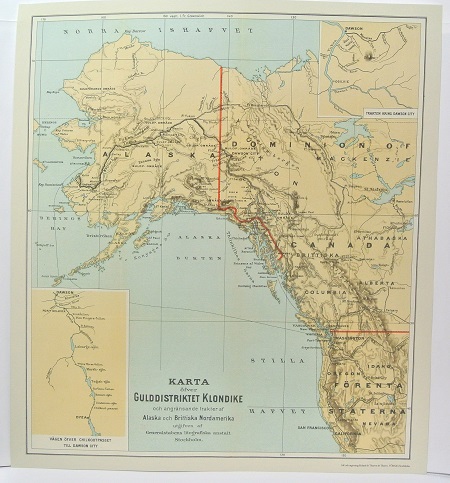
Gulddistriktet Klondike - ca 1897.
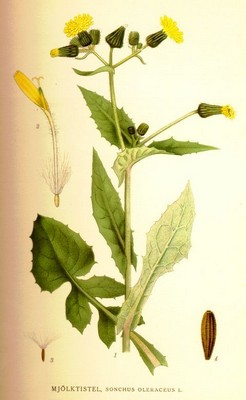
Mjölktistel, Sonchus oleraceus - Lindman, C. A. M, Bilder ur Nordens Flora 1917-26.
